
Most companies do not have a shortage of digital tools. They have a shortage of connection between those tools. A website may generate form submissions, paid campaigns may produce clicks, search engine optimization may increase visibility, and a CRM may store contacts. Revenue still leaks away when those systems do not share context, ownership, timing, and measurement.
A connected digital growth system solves that problem. It brings marketing, technology, customer experience, and revenue operations into one coordinated framework. Every component has a defined job, every important action creates usable data, and every qualified opportunity has a next step.
This guide explains what a connected digital growth system is, why it matters for Denver businesses, how its core components work together, and how to build one without turning the project into an expensive collection of software subscriptions.
What is a connected digital growth system?
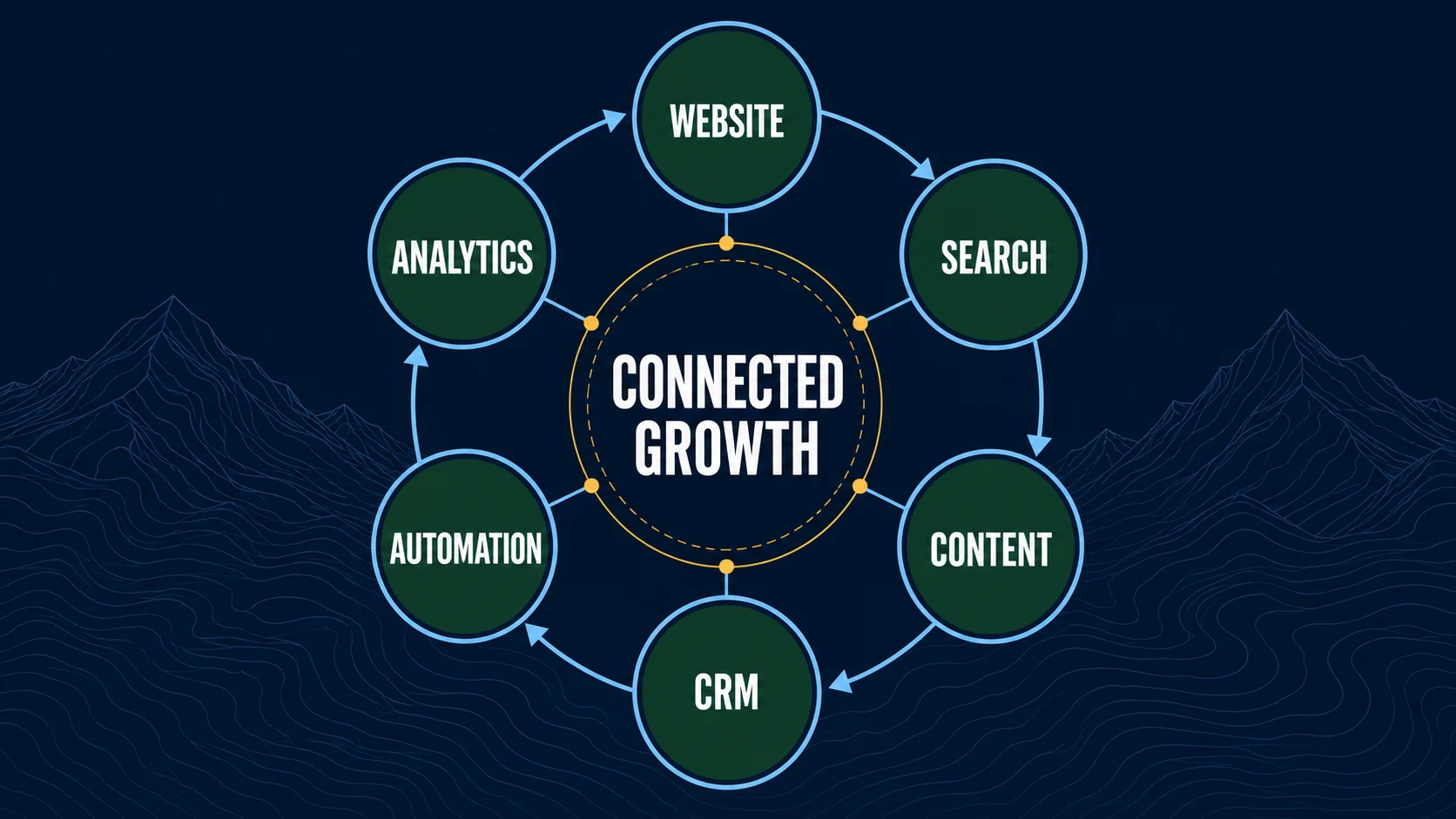
A connected digital growth system is an integrated set of digital experiences, marketing channels, applications, data, and operational workflows designed to move people from discovery to measurable business outcomes. It connects the public website with search, advertising, content, forms, customer relationship management, automation, sales activity, and analytics.
The important word is connected. A high-performing website alone cannot compensate for slow lead response. Strong search rankings can create demand, but they do not guarantee that the CRM records the original source. Automation can improve consistency, but poorly designed automation can also send irrelevant messages and damage trust. Each capability becomes more valuable when it contributes to one intentional customer journey.
For leadership teams, the practical result is better visibility. They can see how attention becomes an inquiry, how an inquiry becomes a qualified opportunity, and how opportunities contribute to revenue. For customers, the result is a faster and more coherent experience.
Why disconnected marketing creates lead leakage
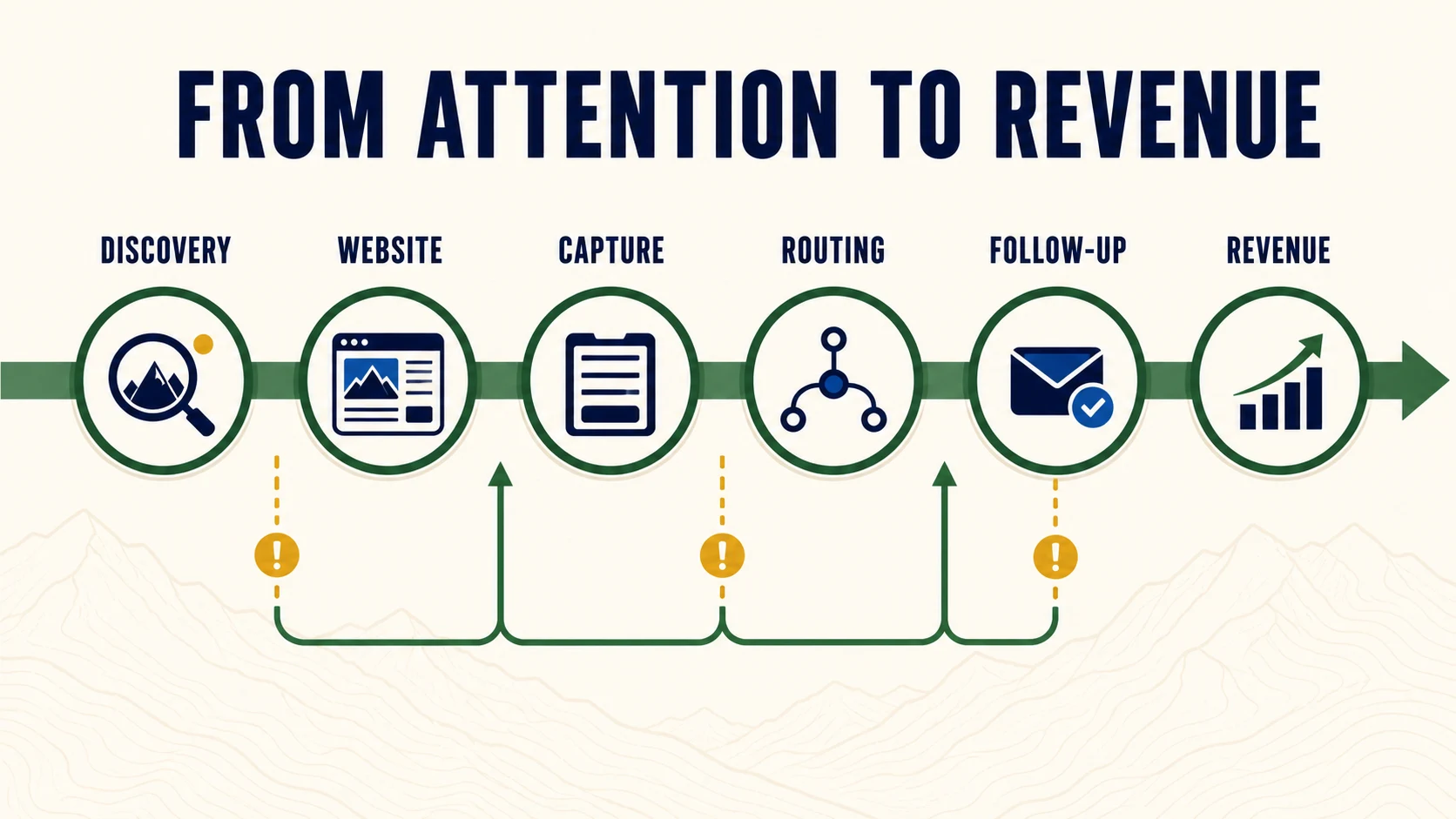
Lead leakage occurs when a potentially valuable customer disappears because the path from interest to action breaks down. The problem may happen before a form is submitted, after the submission reaches an inbox, during qualification, or while the prospect waits for follow-up.
Common causes include slow websites, unclear calls to action, forms that ask for the wrong information, missing CRM integrations, duplicate records, weak routing rules, delayed notifications, inconsistent sales follow-up, and analytics that stop at the lead instead of following the opportunity through the pipeline.
These failures are easy to miss because every department can appear busy. Marketing reports traffic and leads. Sales reports calls and proposals. Technology reports uptime. Without a shared system, nobody sees the full journey or the precise point where momentum is lost.
A connected system reduces leakage by assigning responsibility to each transition. It determines what happens when a visitor arrives, what data is captured, where that data goes, who receives it, how quickly the person is contacted, and how the outcome is measured.
The six components of a connected growth system
1. A website designed around customer intent
The website is the public center of the system. It must communicate who the organization serves, what problems it solves, why its approach is credible, and what the visitor should do next. Effective web design and development combines persuasive content, accessible interaction, mobile performance, technical reliability, and clear conversion paths.
Service pages should address specific needs instead of repeating broad claims. Navigation should help visitors self-select. Forms should collect enough information to support qualification without creating unnecessary friction. Calls to action should reflect the visitor's level of intent, from learning more to requesting a consultation.
2. Search visibility across Google, Bing, and AI answers
Search visibility now extends beyond traditional blue links. Customers discover providers through local results, featured snippets, people-also-ask panels, maps, AI-generated answers, industry directories, and conversational assistants. A modern SEO strategy must support both search engines and answer systems.
That requires technically accessible pages, descriptive headings, strong internal links, accurate local business information, useful original content, structured data, and clear evidence of expertise. The goal is not to repeat a keyword as often as possible. The goal is to become the most useful and trustworthy answer for the customer's question.
3. Content that answers real buying questions
Content connects early research with commercial decisions. Useful articles answer questions customers ask before they contact a provider. Case studies demonstrate relevant experience. Service pages explain the process, deliverables, constraints, and fit. Frequently asked questions remove uncertainty.
For AEO and GEO visibility, content should provide direct answers near the beginning, use clear terminology, define important concepts, and support claims with specifics. Search and AI systems need enough context to understand the organization, its services, its geography, and the relationship between its pages.
Content should also connect to action. An educational article can link to a relevant service, a diagnostic conversation, or another resource. That internal structure helps customers continue their journey and helps search systems understand topical relationships.
4. CRM and lead-routing infrastructure
When someone submits a form, the information should not disappear into a generic inbox. A connected CRM creates or updates the person, associates the correct company, records the opportunity, preserves the source, and assigns ownership.
Routing rules can use service interest, geography, company size, urgency, or another relevant field. Notifications should reach the right person immediately. Duplicate management should prevent fragmented records. Consent and data-retention requirements should be built into the workflow.
This is where a website stops behaving like a brochure and becomes part of the revenue operation. Denver Media Group focuses on integrations that preserve the context sales teams need to have a productive first conversation.
5. Automation that improves response without removing judgment
Automation is most useful when it handles predictable coordination. It can confirm that an inquiry was received, alert the correct team member, create follow-up tasks, enrich a record, schedule reminders, and provide relevant information while a prospect waits.
It should not pretend that every lead is identical. High-value or complex opportunities often require human judgment. The best automation supports that judgment by delivering context and reducing administrative delay.
AI solutions and automation can help classify inquiries, summarize conversations, recommend content, identify missing information, and surface patterns. Those capabilities need governance, approved data access, auditability, and a clear escalation path.
6. Analytics connected to pipeline and revenue
Traffic, impressions, rankings, and conversion rates are useful indicators, but they are not the final business outcome. A connected measurement plan follows the journey from source to qualified opportunity, proposal, closed business, and customer value.
The organization should define shared lifecycle stages and the events that move a record forward. Website analytics, advertising platforms, call tracking, forms, and the CRM should use consistent campaign and source information. Dashboards should separate meaningful signals from activity that looks impressive but does not influence revenue.
This makes optimization more disciplined. Teams can improve the pages, campaigns, audiences, messages, and workflows that produce quality outcomes instead of simply buying more traffic.
How to build the system in the right order
Trying to rebuild everything at once creates risk. A better approach begins with the revenue constraint. Determine where qualified opportunities are currently being lost or delayed. Review the customer journey, website experience, acquisition channels, form behavior, CRM workflow, response times, and reporting.
Next, establish the measurement foundation. Define conversions, lifecycle stages, source fields, ownership, and success metrics before adding new automation. Clean data and clear definitions are more important than an elaborate dashboard.
Then improve the highest-impact connection. That may mean rebuilding a service page, simplifying a form, connecting forms to the CRM, adding immediate routing, improving local search visibility, or repairing campaign attribution. Deliver the change, measure the result, and continue through the next constraint.
This iterative method creates value sooner and reduces the chance of designing around assumptions. It also gives stakeholders evidence that the system is becoming more useful with each release.
What should Denver businesses prioritize?
Denver is a competitive and rapidly changing market. Local companies compete with established Colorado organizations, national brands, remote providers, and AI-assisted buying experiences. A generic digital presence is rarely enough.
Local relevance should be specific and authentic. Pages should explain the areas served, the organizations supported, and the experience relevant to Colorado customers. Accurate business information, location context, local links, reviews, and community credibility can reinforce search visibility. Local optimization must still be supported by a useful offer and a strong customer experience.
Businesses should also prioritize mobile performance, accessibility, trustworthy content, first-party data, fast lead response, and reporting that connects marketing to sales. These fundamentals create resilience as search interfaces and advertising platforms change.
How AEO and GEO fit into the system
Answer engine optimization, or AEO, improves the likelihood that content will be selected for direct answers, snippets, and conversational results. Generative engine optimization, or GEO, improves how clearly an organization and its expertise can be understood and represented by generative AI systems.
Both depend on the same foundation as good SEO: crawlable pages, clear information architecture, concise answers, descriptive entities, credible evidence, structured data, and consistent information across the web. They also reward content that goes beyond vague promotion.
This article uses a direct summary, a definition, descriptive headings, internal links, detailed explanations, and FAQs because those elements help people and machines find the information they need. The strategy is not about writing for robots. It is about making expert information easier to retrieve, interpret, and trust.
How to measure whether the system is working
Choose a small group of metrics that represent the complete journey. Useful measures include qualified organic visibility, engaged visits to priority service pages, conversion rate, form completion rate, speed to first response, qualified-opportunity rate, pipeline value by source, close rate, customer acquisition cost, and revenue influenced.
Review the metrics together. A higher conversion rate is less valuable if lead quality collapses. More organic traffic is not enough if visitors reach irrelevant pages. Faster response matters most when the process routes each inquiry to someone prepared to help.
The strongest signal is operational clarity. Teams should know where opportunities come from, what happens next, and which improvement deserves attention. When that clarity exists, marketing and technology investments become easier to prioritize.
Frequently asked questions
What is the first step in building a connected digital growth system?
Map the current customer journey from discovery through sales follow-up. Identify the most significant point of friction or lead leakage, define how it will be measured, and improve that connection before adding more tools.
Does a small business need an expensive marketing technology stack?
No. A small organization often needs fewer tools with clearer responsibilities. A reliable website, practical analytics, a configured CRM, and simple routing automation can create a strong foundation.
How is a connected growth system different from digital marketing?
Digital marketing focuses on attracting and converting attention. A connected growth system also includes the website, CRM, operational workflows, sales response, data governance, and revenue measurement.
Can AI improve a digital growth system?
Yes. AI can classify inquiries, summarize information, identify patterns, and support automation. It should operate within approved permissions, protect sensitive data, retain audit records, and escalate decisions that require human judgment.
How long does it take to build a connected growth system?
The timeline depends on the existing website, data quality, integrations, and operational complexity. Many organizations can improve a high-impact connection within several weeks, then expand through measured phases.
How does local SEO support a Denver growth strategy?
Local SEO helps nearby customers understand where a company operates, what it offers, and why it is relevant. Accurate business information, locally useful pages, reviews, links, structured data, and Google Business Profile management support visibility.
READY TO CONNECT THE SYSTEM?
Turn disconnected digital activity into measurable growth.
Denver Media Group connects websites, search visibility, AI, CRM workflows, automation, and analytics around the way your customers buy. We can identify where opportunities are leaking, prioritize high-impact improvements, and build a practical roadmap tied to revenue.
Request a digital growth assessment