Conversion Rate Optimization Denver

TLDR
Conversion rate optimization turns more of your existing website traffic into qualified leads, appointments, purchases, and revenue. Effective conversion rate optimization in Denver requires clear customer journeys, reliable analytics, focused testing, strong landing pages, and disciplined follow-up,not isolated design changes.
Key Takeaways
| Point | Details |
|---|---|
| CRO improves business outcomes | The objective is not merely more clicks. It is more qualified leads, sales, appointments, and revenue from the traffic you already attract. |
| Measurement comes first | Analytics, CRM data, call tracking, and form reporting should establish where prospects leave the customer journey. |
| Research guides testing | Customer interviews, search intent, recordings, heatmaps, and funnel data reveal higher-value opportunities than guesswork. |
| Landing pages need message continuity | Pages convert more effectively when the offer, headline, proof, and call to action align with the visitor’s source and intent. |
| Lead handling affects conversion | Fast routing, useful CRM stages, automation, and sales follow-up prevent acquired demand from leaking after form submission. |
| CRO is an operating system | Sustainable gains come from repeated research, prioritization, implementation, testing, and revenue analysis. |
Table of Contents
What Is Conversion Rate Optimization?
Conversion rate optimization, or CRO, is the systematic process of increasing the percentage of website visitors who complete a valuable action. Depending on the business, that action might be submitting a form, booking an appointment, requesting an estimate, calling a sales team, completing checkout, or starting a software trial.
The basic calculation is completed conversions divided by total eligible visitors, multiplied by 100. A website receiving 5,000 monthly sessions and 100 qualified inquiries has a 2% session-to-inquiry rate; increasing that rate to 3% would generate 50 additional inquiries without requiring more traffic. The right denominator and conversion, however, must reflect the actual business model rather than a convenient vanity metric.
Strong website conversion optimization in Denver connects user experience with traffic quality, offer design, technical performance, analytics, CRM stages, and sales outcomes. It should complement Services, Why Hiring An Agency To Design And Develop A Website Just Makes Sense, and paid acquisition so that marketing investment creates measurable pipeline rather than disconnected activity.

Why Conversion Rate Optimization Denver Strategies Need Local Context
Denver businesses compete across a mixed market that includes local service providers, healthcare organizations, restaurants, professional services, tourism companies, construction firms, technology companies, and national brands. Search behavior can also vary by neighborhood, service area, season, device, urgency, and whether a prospect is comparing local providers or researching a complex purchase.
Effective Denver CRO services account for those differences without reducing the strategy to cosmetic localization. A visitor searching for an emergency service needs immediate reassurance, location coverage, proof, and a direct phone action; a B2B buyer evaluating a custom platform may need technical detail, case studies, integration information, and a lower-friction discovery call.
A conversion problem is rarely just a button problem. It is usually a mismatch among visitor intent, message clarity, credibility, page experience, offer design, measurement, or follow-up.
Mobile performance and accessibility are equally important. Google’s PageSpeed Insights can help identify performance constraints, while the W3C Web Content Accessibility Guidelines provide the recognized framework for accessible digital experiences. Removing speed, readability, keyboard, contrast, and form usability barriers expands access while reducing avoidable abandonment.
A Practical CRO Process
A disciplined CRO program begins with instrumentation. Configure analytics around meaningful events, preserve campaign attribution, connect forms and calls to the CRM, and define the stages between first visit and closed revenue. Google’s official Analytics events documentation explains the event-based model, but implementation should reflect the decisions your business needs to make.
Next, combine quantitative evidence with qualitative research. Funnel reports show where users leave, while interviews, support questions, on-site searches, usability reviews, heatmaps, and session recordings help explain why. A CRO consultant in Denver should then translate that evidence into testable hypotheses with an expected business impact,not deliver a generic list of design preferences.
| Stage | Key Question | Useful Evidence | Example Action |
|---|---|---|---|
| Measure | Where is opportunity being lost? | Analytics, CRM stages, call data, form errors | Repair missing events and establish baseline rates |
| Research | Why are visitors hesitating? | Interviews, recordings, surveys, search queries | Identify unanswered questions and friction |
| Prioritize | Which change has the best expected return? | Traffic, severity, effort, strategic value | Rank hypotheses using a consistent scoring model |
| Implement | Can the change be delivered reliably? | Design, development, QA, accessibility review | Build the variant and verify tracking |
| Evaluate | Did the change improve qualified outcomes? | Conversion rate, lead quality, pipeline, revenue | Adopt, revise, or reject the hypothesis |
Pro Tip: Prioritize opportunities using potential impact, supporting evidence, implementation effort, and traffic exposure. Do not run an A/B test simply because a tool makes testing easy; low-traffic businesses may learn faster through usability testing, sequential releases, customer feedback, and careful before-and-after analysis.

How to Improve Landing Pages and Lead Generation
Denver landing page optimization starts with message continuity. The headline should confirm the promise made by the ad, search result, email, or referral source, while the supporting copy should explain who the offer is for, what outcome it creates, why the company is credible, and what happens after the visitor responds. That continuity reduces the mental work required to decide.
A high-converting page generally includes a specific value proposition, relevant proof, concise service details, objection handling, a clear primary action, and only the form fields required for the next step. It should also load quickly, work on small screens, preserve readable contrast, and provide meaningful validation when form errors occur. The web.dev Core Web Vitals guidance offers a useful technical reference for evaluating real-world page experience.
- Clarify the outcome: Replace broad claims with a concrete customer result.
- Match visitor intent: Build pages around distinct services, audiences, or campaign promises.
- Strengthen proof: Use relevant case studies, testimonials, credentials, and transparent process details.
- Reduce form friction: Ask only for information needed to route or qualify the inquiry.
- Set expectations: Explain response times and what the next conversation includes.
- Test the full journey: Verify confirmation messages, notifications, CRM records, automation, and mobile behavior.
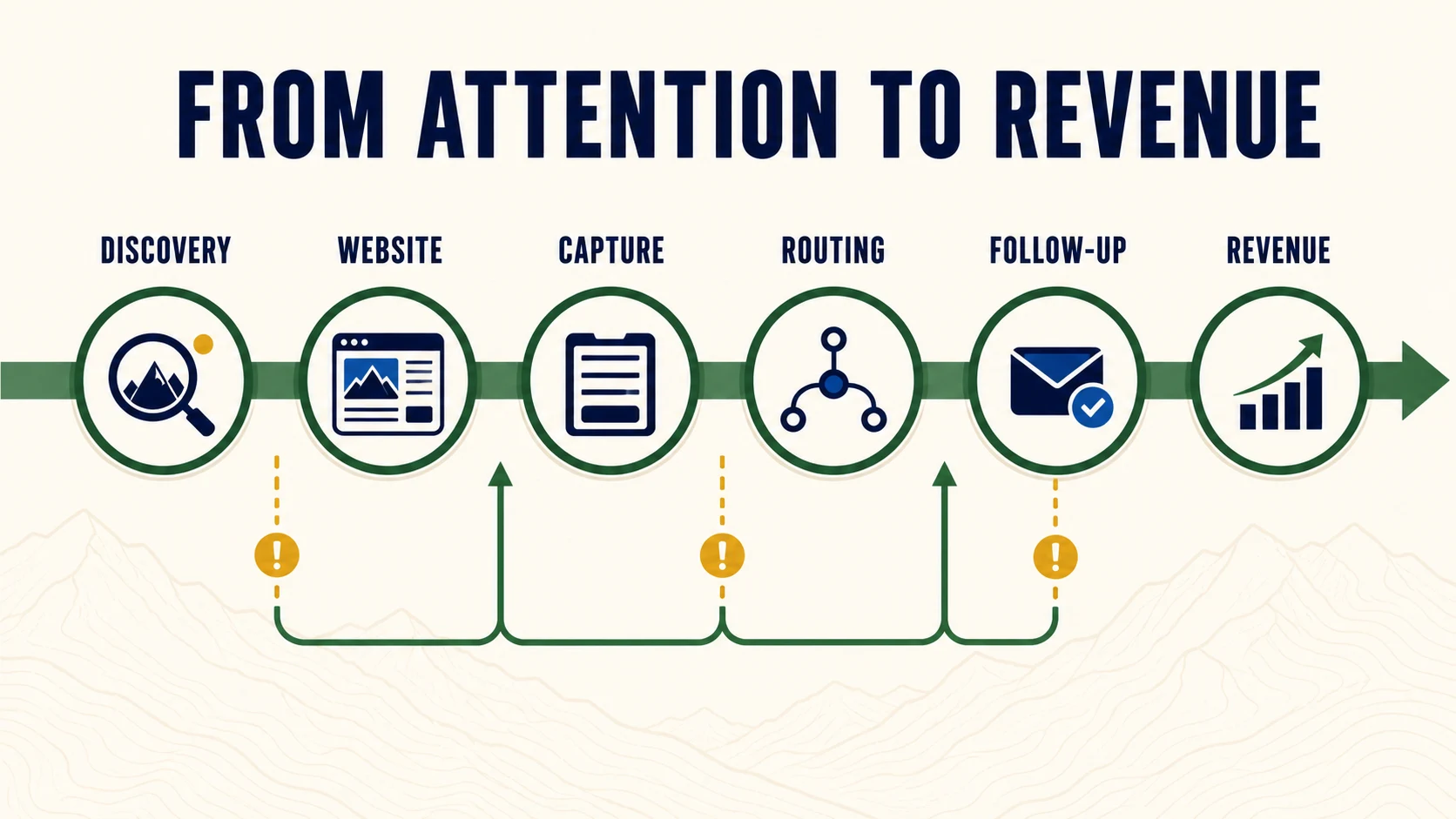
The work should continue after submission. Connecting CRM and revenue operations solutions, marketing analytics and reporting, and practical automation helps route leads, trigger timely responses, and show which campaigns create qualified pipeline. Otherwise, a page can report more conversions while the business still loses revenue through delayed or inconsistent follow-up.
How to Choose a Denver CRO Partner
A conversion optimization agency in Denver should be able to diagnose the whole journey rather than optimizing pages in isolation. Ask how the team distinguishes traffic-quality problems from page problems, validates analytics, protects accessibility, evaluates statistical evidence, integrates CRM data, and reports on lead quality. A credible partner should also explain when testing is inappropriate because traffic or conversion volume is too low.
Before hiring a CRO consultant in Denver, establish the business outcome, current baseline, available traffic, implementation resources, and decision horizon. Review whether the engagement includes research, copy, UX, design, development, quality assurance, analytics, experimentation, and post-conversion operations; gaps between those disciplines often slow progress or produce recommendations that never ship.
- Request a measurement and tracking audit before accepting performance claims.
- Ask for hypotheses tied to customer evidence and commercial outcomes.
- Confirm who will implement, test, and quality-check each change.
- Require reporting on qualified leads, opportunities, and revenue where possible.
- Review how findings will inform Financial Healthcare Custom Application Development, content, media, and sales operations.
The strongest operating model connects acquisition, website experience, data, CRM, and revenue. DMG approaches CRO within that connected system, using high-performance digital experiences, analytics, practical AI and automation, SEO, and revenue operations to reduce lead leakage and turn attention into measurable opportunity.

Frequently Asked Questions
What is conversion rate optimization?
Conversion rate optimization is the structured process of increasing the percentage of visitors who complete a valuable action, such as submitting a qualified inquiry or making a purchase. It uses analytics, customer research, UX improvements, technical changes, and testing to improve measurable outcomes.
How much do Denver CRO services cost?
Pricing depends on website complexity, traffic volume, analytics maturity, research requirements, and whether implementation is included. A focused audit may be a defined project, while an ongoing program typically requires recurring research, development, testing, and reporting.
How long does conversion rate optimization take?
Tracking repairs and obvious usability fixes may produce useful improvements within weeks, but a reliable CRO program usually operates over several months. Timing depends on traffic, conversion volume, technical capacity, sales-cycle length, and the number of changes being evaluated.
What is a good website conversion rate for a Denver business?
There is no universal good rate because conversions vary by industry, offer, traffic source, device, price, and qualification criteria. The useful benchmark is your own accurately measured baseline, segmented by audience and evaluated against lead quality and revenue.
Does a small business have enough traffic for A/B testing?
Many small businesses do not have enough traffic or conversions to reach reliable A/B test conclusions quickly. They can still improve through user interviews, usability tests, analytics reviews, form analysis, customer feedback, and carefully measured sequential changes.
What should a CRO audit include?
A CRO audit should examine analytics accuracy, funnel performance, traffic intent, page messaging, mobile usability, accessibility, speed, forms, proof, calls to action, CRM routing, and follow-up. It should conclude with prioritized hypotheses, evidence, expected impact, effort, and measurement requirements.
Is landing page optimization different from CRO?
Landing page optimization is one part of CRO focused on improving a specific page and its immediate conversion action. CRO is broader because it also addresses acquisition quality, multi-page journeys, technical performance, analytics, CRM processes, and downstream revenue.
How do I measure whether CRO is increasing revenue?
Connect website events and campaign data to CRM stages, qualified opportunities, transaction values, and closed revenue. Compare conversion quality and economic value,not only form volume,while accounting for traffic mix, seasonality, sales-cycle length, and implementation changes.