Web Design and Development · Content Strategy · SEO and AEO
National Defense Lab
A mission-driven website redesign that gives National Defense Lab a clearer platform for communicating defense capabilities, active programs, research, and partnership opportunities.
THE WORK
Built around a real business objective.
A digital platform built for mission clarity
National Defense Lab develops practical solutions where emerging technology, public service, and national security meet. Denver Media Group designed and developed a new website that translates that complex mission into a clear public experience for government, defense, research, technology, and mission-aligned audiences.
The website needed to do more than present an organization. It had to explain a broad portfolio of advanced capabilities, introduce active programs, support ongoing thought leadership, and create a credible path for partnership conversations. The result is a structured digital platform built around clarity, consequence, and preparedness.
Positioning grounded in purpose
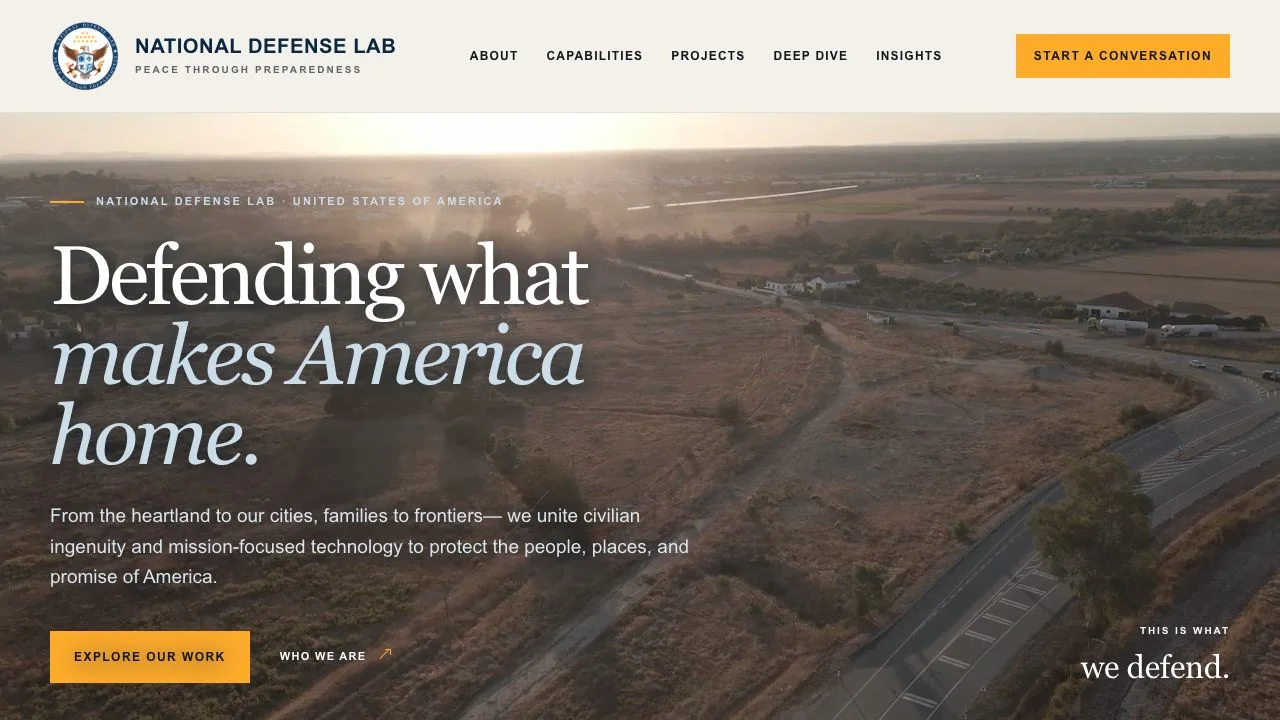
The experience opens with a direct organizing idea: defending what makes America home. That statement gives the brand an immediate human center while supporting the larger themes of national preparedness, civilian ingenuity, and mission-focused technology.
Rather than leading with technical terminology alone, the homepage connects National Defense Lab's work to the people, places, and promise it is designed to protect. Supporting language then moves the visitor from purpose into evidence, capabilities, and active programs. This sequence makes a sophisticated organization easier to understand without reducing the seriousness of its work.
Information architecture for complex capabilities
Denver Media Group organized the website around clear top-level pathways for About, Capabilities, Projects, Deep Dive, Insights, and Contact. The structure lets different audiences enter according to their needs, whether they are evaluating technical expertise, exploring a specific program, reviewing research, or considering a partnership.
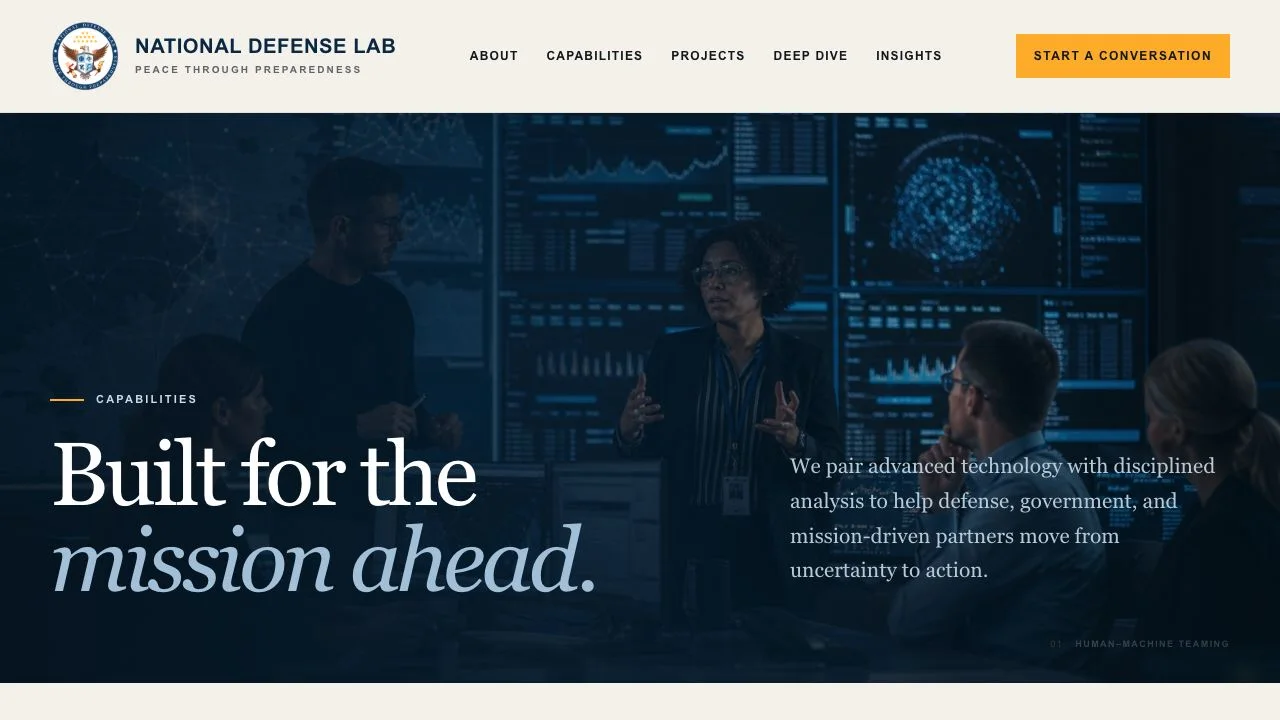
The capabilities system turns a wide field of work into six distinct areas: Human-Machine Teaming, Autonomous Systems, Information Resilience, Open Source Intelligence, Artificial Intelligence, and Signature Reduction. Each capability receives its own focused page, consistent structure, and clear relationship to the larger National Defense Lab mission.
This architecture supports people and search systems at the same time. Descriptive headings, stable page relationships, concise summaries, internal links, and focused URLs help visitors scan the portfolio while giving search and AI answer systems clearer context about each area of expertise.
Connecting capabilities to active programs
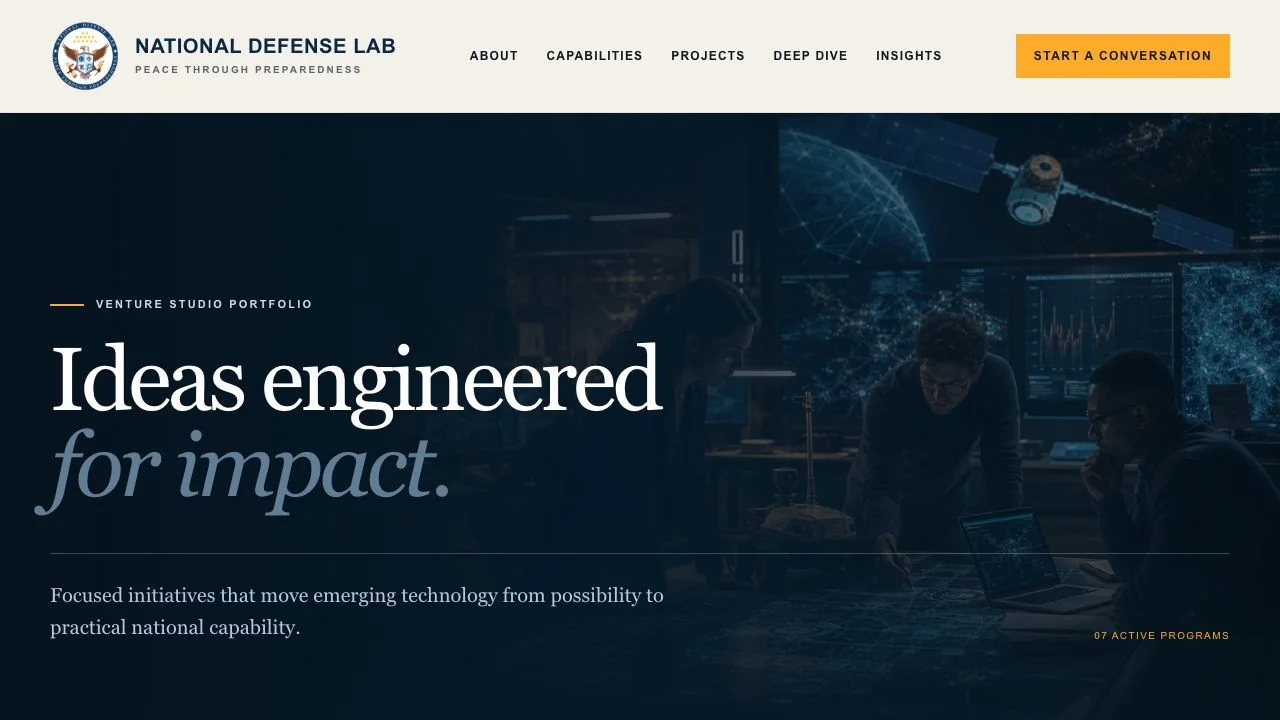
Capabilities establish what an organization can do. Programs show how that expertise becomes tangible work. The website creates a dedicated project layer for initiatives including Project MNEMOSYNE, Project ATHENA, and Project STELLAR.
The homepage introduces those programs as a progression from insight to impact, then directs visitors into the broader project experience. This gives National Defense Lab room to present current work without overwhelming the opening message. It also creates a scalable publishing model for adding future programs as the portfolio develops.
A visual system with institutional credibility
The design pairs National Defense Lab's seal with a restrained visual system drawn from deep navy, warm white, and mission-orange accents. Editorial serif typography gives major ideas gravity, while clean sans-serif navigation and labels support fast scanning. Large documentary imagery connects advanced technology with the American communities and landscapes the mission serves.
Numbered sections, precise labels, measured spacing, and controlled motion create a disciplined rhythm across the site. Capability cards use distinct imagery and consistent presentation, while project sections shift into a darker operational palette. The system feels credible and contemporary without relying on familiar defense-industry visual clichés.
Research and insight pathways built to grow
The Deep Dive and Insights sections provide separate paths for enduring research and timely organizational publishing. This distinction lets National Defense Lab develop authority through detailed analysis while maintaining a steady stream of news, commentary, program updates, and event information.
A reusable editorial system supports clear titles, publication context, related topics, and connections back to relevant capabilities or projects. That foundation is important for traditional search visibility and for AI discovery, where well-structured, attributable, and specific information is easier to retrieve and interpret.
Accessible and responsive by design
The website includes practical accessibility foundations such as a skip-to-content link, semantic navigation, logical heading structure, descriptive link language, keyboard-aware controls, readable contrast, and responsive layouts. These details help people using assistive technology and improve the experience for every visitor navigating a content-rich site.
The responsive system preserves the hierarchy and visual character of the desktop experience on smaller screens. Navigation, capability cards, program content, calls to action, and long-form material adapt without losing their relationship to the larger mission.
A focused path from understanding to conversation
Calls to action are integrated throughout the experience rather than isolated at the bottom of a page. Visitors can explore the work, understand the organization, review capabilities, examine active programs, and start a conversation when they have enough context to engage.
The contact experience collects the information National Defense Lab needs to route an inquiry, including organization, area of interest, and mission details. This makes the website part of an operational relationship-building process instead of a static institutional brochure.
Project focus
- Brand positioning and digital strategy
- Website design and responsive development
- Information architecture and content strategy
- Capability and program publishing systems
- Thought leadership and insights architecture
- SEO, AEO, and AI-search-ready page structure
- Accessibility and semantic front-end development
- Contact and partnership conversion pathways
The outcome
The new National Defense Lab website provides a clearer and more durable platform for explaining high-consequence work. It brings mission, capabilities, programs, research, and contact pathways into one coherent system while giving the organization room to expand.
This case study describes the delivered digital experience and its strategic design. It does not make unverified claims about traffic, rankings, program outcomes, or mission performance.