
Search discovery is no longer limited to a list of ten blue links. A prospective customer may ask Google, Bing, ChatGPT, Gemini, Perplexity, or another assistant to compare approaches, define a service, recommend a Denver provider, or explain what to evaluate before making a decision. The answer may combine information from several sources before the person ever reaches a company website.
That change creates a new visibility challenge. A business can rank for familiar keywords and still be absent from generated answers. It can publish excellent work and still make its expertise difficult for an answer system to interpret. It can claim local relevance without giving search systems enough consistent evidence to connect the brand with Denver, Colorado, its services, and the problems it solves.
A practical GEO and AEO strategy closes those gaps. It makes valuable information easier to find, extract, attribute, and trust while preserving the fundamentals of search engine optimization.
What do GEO and AEO mean?
Answer engine optimization, or AEO, structures information so search engines and assistants can identify concise, useful answers to specific questions. It supports featured snippets, people-also-ask results, voice answers, knowledge panels, and conversational responses.
Generative engine optimization, or GEO, improves how clearly generative systems can understand an organization, retrieve its information, and include it in synthesized answers. GEO considers the relationship among content, entities, evidence, citations, brand consistency, and the sources that validate a claim.
The two disciplines overlap. Both benefit from crawlable pages, descriptive headings, direct definitions, topical depth, reliable facts, schema markup, and consistent information across the web. Neither replaces traditional SEO. They extend it into search experiences where the result is an answer rather than a conventional ranking.
How is AI search optimization different from traditional SEO?
Traditional SEO often evaluates whether a page can rank for a query. AI search optimization also evaluates whether a passage can support an answer. A page may be relevant, but an answer system still needs to determine what the claim means, who made it, whether it is current, how it relates to the question, and whether other sources support it.
This means a strong page needs more than a target phrase. It needs clear language, logical relationships, appropriate detail, and evidence. A service page should explain the service, audience, process, outcomes, limitations, and next step. An educational article should answer the central question early, expand the explanation, define related concepts, and make claims that can be verified.
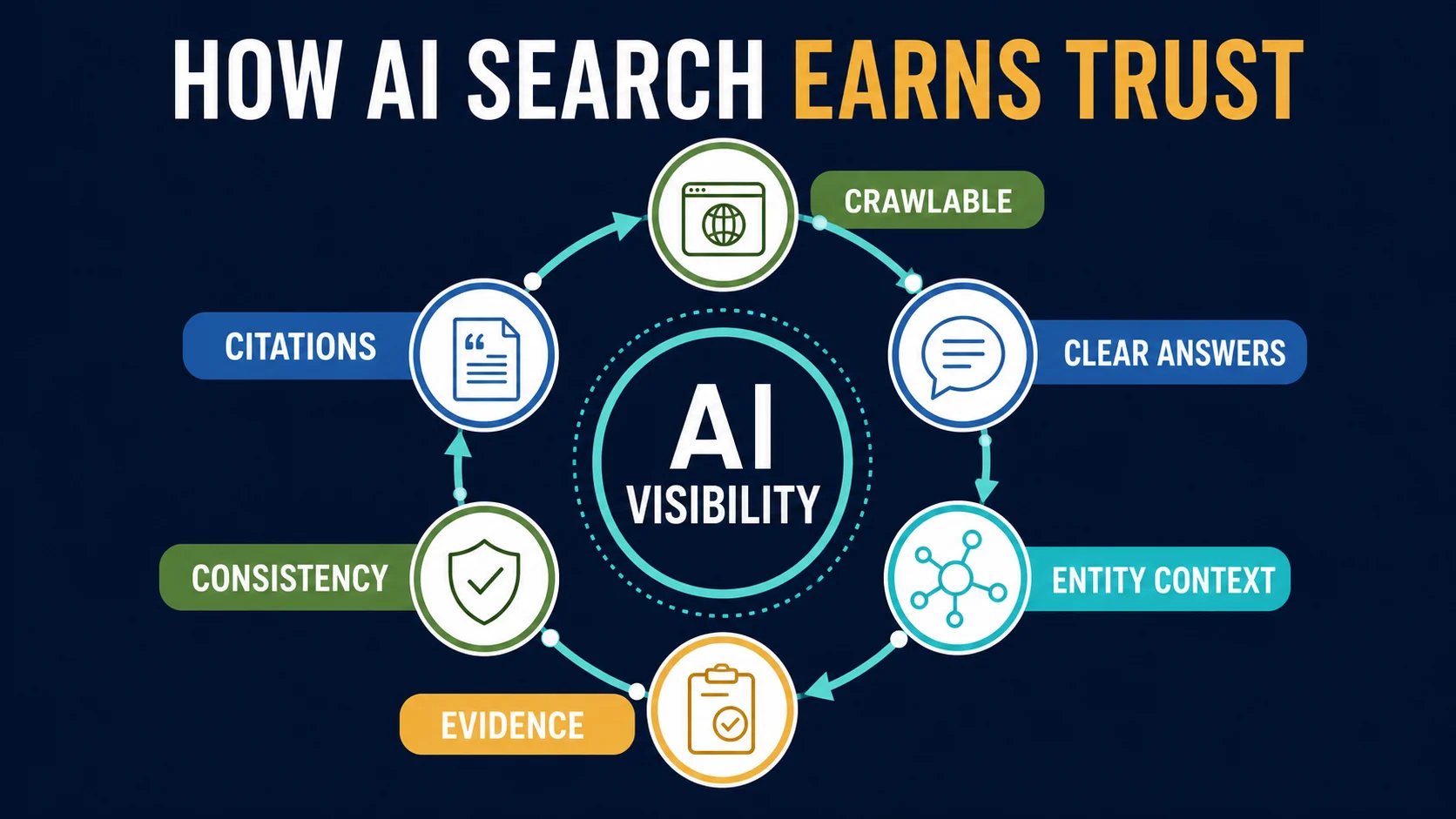
The six foundations of GEO and AEO visibility
1. Crawlable and indexable information
Answer systems cannot reliably use information that search engines cannot access. Important pages should return a successful status code, use stable URLs, load meaningful content in the initial response, and avoid accidental blocking in robots directives. Canonical tags should identify the preferred URL. XML sitemaps should include current public pages and exclude administrative, duplicate, or private content.
JavaScript can support a sophisticated experience, but critical copy, links, headings, and metadata should remain available to crawlers. Performance, mobile usability, accessibility, and semantic HTML also improve the quality of the experience for people and machines.
2. Direct answers supported by deeper context
A page should answer its primary question near the beginning. That does not mean every article should be short. It means readers should not have to cross several promotional paragraphs to understand the central idea. A concise summary can be followed by examples, processes, evidence, exceptions, and related questions.
Descriptive H2 and H3 headings help systems identify sections that correspond to specific intent. Lists, tables, definitions, and FAQs can make complex information easier to scan when they genuinely improve clarity. Formatting should support the answer rather than exist only for a crawler.
3. Entity and local business context
An entity is a recognizable person, organization, place, service, or concept. Denver Media Group, Denver, web development, and generative engine optimization are examples of entities that can be related through content and structured data.
A Denver business should consistently state its official name, services, location, contact information, service area, and relevant expertise. The website, Google Business Profile, social profiles, directories, and authoritative mentions should not tell conflicting stories. Local context is strongest when it reflects real experience, useful Colorado information, local projects, community relationships, and customers served, not when a city name is inserted into generic copy.
4. Evidence, experience, and specific claims
Generated answers must choose among thousands of similar claims. Vague language such as best-in-class, innovative, or results-driven does little to separate one provider from another. Specific processes, named deliverables, original research, measured case studies, expert biographies, and clearly qualified outcomes give systems more useful material.
Evidence must remain honest. A documented result should explain the context and avoid implying a guarantee. Statistics should identify a reliable source. Content should show when it was published or updated. When a topic can affect health, money, law, or safety, editorial review and source quality become even more important.
5. Consistency across the digital footprint
Consistency reduces ambiguity. Use one preferred company name, one canonical domain, accurate addresses and phone numbers, and aligned service descriptions. Redirect outdated domains and duplicate URLs. Keep social profiles and business listings current. Correct conflicting legacy references that could cause a system to associate the brand with the wrong organization or location.
Consistency also applies within the website. Service pages, articles, case studies, and calls to action should reinforce the same positioning. Internal links should connect related topics so a visitor and a crawler can understand which page provides the authoritative explanation.
6. Citations and independent corroboration
A business cannot manufacture trust entirely on its own domain. Relevant mentions from customers, partners, professional organizations, local media, respected directories, podcasts, events, and industry publications provide independent context. The objective is not to collect low-quality links. It is to earn references where the organization's expertise is relevant.
Useful public resources can earn citations over time. Original data, detailed checklists, transparent comparisons, local research, and practical tools give other writers a reason to reference the business. Digital public relations and expert participation can distribute that knowledge to credible audiences.
A practical local GEO strategy for Denver businesses
Begin with the questions customers ask during discovery, evaluation, and purchase. A Denver professional-services firm may need content about cost, timing, process, local requirements, common risks, and provider selection. A local retailer may need product availability, neighborhood information, delivery areas, comparisons, and care guidance.
Create one strong page for each primary service and customer intent. Support those pages with articles that answer narrower questions. Add relevant local details, but avoid creating dozens of nearly identical city pages. Google Business Profile information should match the website. Reviews should be requested ethically and answered thoughtfully. LocalBusiness or Organization schema should reflect visible, accurate information rather than hidden claims.
Then strengthen the network around the content. Link educational articles to the appropriate service. Link services to related examples. Use descriptive anchor text. Update older pages when facts change. A connected information architecture helps search systems understand which page should answer which question.
Content formats that AI answer systems can use
Definitions, step-by-step processes, checklists, comparison tables, frequently asked questions, case studies, glossaries, and original research are especially useful when the format matches the question. An article should not force every idea into a list. It should use the clearest format for the subject.
Include the assumptions and constraints behind advice. If a recommendation changes based on company size, industry, geography, or existing technology, say so. Nuance improves usefulness and demonstrates judgment. That is more valuable than producing large volumes of repetitive content.
Technical signals and structured data
Structured data can identify articles, organizations, local businesses, services, breadcrumbs, authors, videos, products, and other supported entities. It should describe content that visitors can see. Valid schema does not guarantee a rich result or an AI citation, but it reduces ambiguity and helps machines interpret relationships.
Technical teams should also review title tags, meta descriptions, canonical URLs, heading hierarchy, image alternative text, internal links, status codes, page speed, and accessibility. Use a single preferred HTTPS domain. Maintain accurate robots and sitemap files. Monitor indexing and enhancements in Google Search Console and Bing Webmaster Tools.
How to measure GEO and AEO progress
No universal dashboard can report every AI-generated mention with complete accuracy. Measurement should combine several signals. Track impressions and clicks for question-based searches, visibility of priority pages, branded search demand, referral traffic from assistants when available, citations observed in representative prompts, assisted conversions, and qualified inquiries.
Create a stable set of questions that reflect real customer intent. Review results periodically from a clean environment and record which sources are cited. Treat the results as directional because answers can change by model, location, personalization, and date. Connect visibility to meaningful outcomes instead of celebrating a mention that produces no engagement.
A 90-day implementation roadmap
Days 1 through 30: establish the foundation
Audit crawlability, indexation, metadata, schema, local listings, analytics, and conversion tracking. Define the organization's core entities and preferred language. Inventory priority questions and map each one to an existing or planned page.
Days 31 through 60: improve the answers
Rewrite priority service pages with direct explanations, stronger evidence, useful headings, and clear next steps. Publish several high-value resources that answer real buying questions. Connect related pages through intentional internal links.
Days 61 through 90: build corroboration and measure
Correct external listings, pursue relevant expert mentions, distribute original resources, and establish a repeatable review process. Measure search visibility, representative AI answers, engagement, and qualified conversions. Use the findings to choose the next content and technical priorities.
Common GEO and AEO mistakes
- Publishing generic AI-written articles without original expertise or review
- Creating unsupported claims and invented statistics
- Repeating city names instead of demonstrating local relevance
- Adding schema that does not match visible content
- Ignoring traditional crawling, indexing, and site performance
- Measuring mentions without connecting them to customer behavior
- Treating GEO as a one-time technical setting rather than an ongoing publishing discipline
The strongest approach is a connected digital growth system. Search visibility, useful content, conversion paths, CRM workflows, and analytics should work together. Attention only creates value when the customer can take a clear next step and the business can respond effectively.
Frequently asked questions
What is GEO in digital marketing?
Generative engine optimization improves how clearly generative AI systems can understand, retrieve, attribute, and represent information about a business or topic.
What is AEO in SEO?
Answer engine optimization structures useful information so search engines and assistants can select it for direct answers, featured snippets, conversational responses, and related question experiences.
Does GEO replace traditional SEO?
No. GEO depends on many SEO fundamentals, including crawlability, indexation, content quality, internal linking, authority, structured data, and a strong user experience.
How can a Denver business improve AI search visibility?
Publish direct and evidence-supported answers, maintain consistent local business information, build useful service pages, add accurate structured data, earn credible mentions, and connect visibility to conversions.
Can schema markup guarantee an AI citation?
No. Schema reduces ambiguity, but citations depend on relevance, quality, evidence, authority, availability, and the behavior of each answer system.
How long does GEO and AEO optimization take?
Technical and content improvements can begin within weeks, but durable visibility develops through ongoing publishing, corroboration, testing, and refinement. Timing varies by competition, authority, and crawl frequency.
READY TO BECOME THE CLEARER ANSWER?
Build search visibility for people, Google, and AI answer systems.
Denver Media Group connects SEO, GEO, AEO, content, structured data, analytics, and conversion strategy around measurable growth. We can identify the highest-value questions in your market and build a practical visibility roadmap.
Request an AI search visibility assessment